


To evaluate data privacy, you review how personal information is collected, stored, used, and shared. The process includes mapping data flows, identifying applicable laws like GDPR and CCPA, running a Privacy Impact Assessment, and scoring identified risks. You then create a remediation plan and monitor practices on a regular schedule. A complete evaluation finds gaps before they become breaches.
Most people and businesses assume their data is private. But assumptions are not protection.
Data privacy evaluation is the process that tells you exactly where personal information is going, who has access to it, and what risks exist right now. Without it, you are operating without a clear picture of your actual exposure.
This guide covers everything you need to know to evaluate data privacy the right way. You will learn what a proper evaluation includes, which framework to use, and how to close the gaps you find. By the end, you will have a complete action plan to protect personal information and reduce your organization’s risk profile.
What Is Data Privacy Evaluation?
A data privacy evaluation is a structured review of how an organization, software tool, or internal process handles personal information. It goes far beyond reading a privacy policy. A true evaluation looks at data collection practices, storage security, access controls, data sharing agreements, and compliance with applicable privacy laws.
The goal is direct: find where data protection is working and where it is failing.
Privacy evaluations are used by businesses to meet legal requirements like GDPR and CCPA. They are also used by individuals who want to know whether a service or app can be trusted. Security teams run them to identify weaknesses before a breach occurs.
A data privacy evaluation is not the same as a data security audit, though the two overlap significantly. A security audit focuses on technical controls — firewalls, encryption, access logs. A privacy evaluation focuses on what data exists, why it is collected, and whether collecting it is justified in the first place. Both are necessary. Neither replaces the other.
Why Is Data Privacy Important?
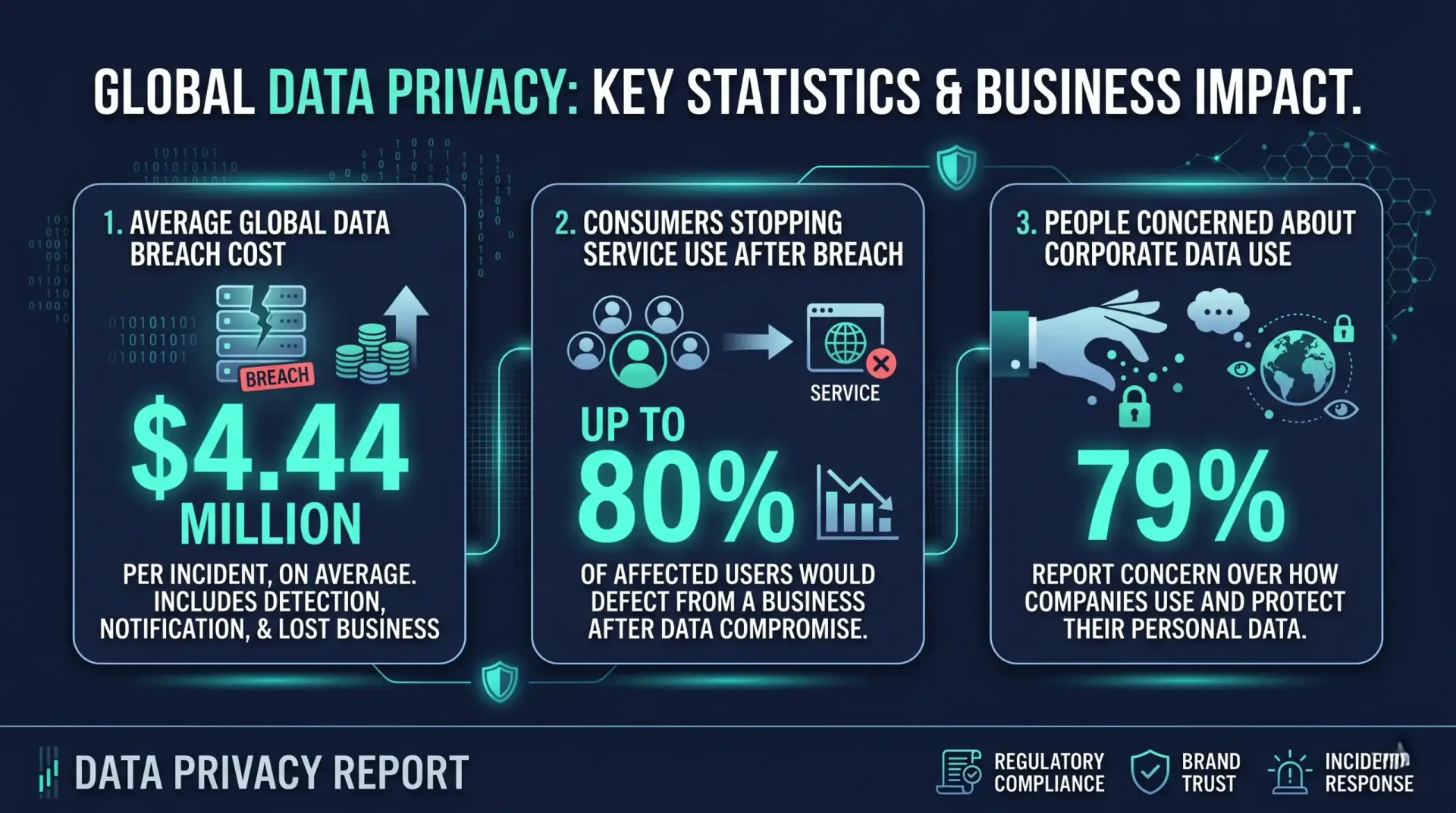
Data privacy matters because personal information is one of the most valuable and most abused assets in the digital world.
When personal data is exposed, the consequences are serious. Individuals face identity theft, financial fraud, and lasting reputational damage. Organizations face regulatory fines, lawsuits, and loss of customer trust. A single breach can cost millions in direct damages and years of recovery effort.
Beyond financial risk, privacy is a fundamental right. People deserve to know who is collecting their data, how it is used, and whether it is sold or shared with third parties.
Research from Pew Research Center shows that a large majority of Americans feel they have very little control over the data companies collect about them. Most people are uncomfortable with how their information is handled, yet they lack the tools to evaluate whether a service is actually trustworthy.
Strong data privacy practices build trust. They protect your customers, your employees, and your organization as a whole. They also reduce the chance of regulatory action from bodies like the FTC or EU data protection authorities.
Why You Need to Evaluate Data Privacy
Many organizations have privacy policies but not privacy practices. These are two very different things.
A written policy describes what you intend to do with data. An evaluation reveals what you are actually doing. The gap between intent and reality is where most privacy failures happen — and where regulators focus their attention during audits.
You need to evaluate data privacy if you:
- Handle customer, patient, or employee personal information
- Use third-party tools that access your data systems
- Operate in a regulated industry such as healthcare, finance, or education
- Have experienced a data breach or a near-miss incident
- Want to demonstrate compliance to regulators, partners, or investors
- Are considering a new software platform or vendor relationship
- Are launching a new product or service that processes personal data
Even small businesses and individual users benefit from evaluating the tools they rely on every day. If an app collects your location, contacts, or financial data, you should know exactly why — and whether that collection is justified by the service you are receiving.
Types of Data Privacy Assessments
Not every evaluation uses the same approach. The right type depends on your goal, your organization’s size, and your regulatory environment. Understanding the differences helps you choose the most appropriate method.
Privacy Impact Assessment (PIA)
A PIA is a formal process used to identify and reduce privacy risks before a new system, project, or process goes live. It is required by law in many jurisdictions for public sector organizations. A PIA answers three core questions: what data will be collected, what risks does that create, and how will those risks be addressed before launch?
Data Protection Impact Assessment (DPIA)
A DPIA is a specific type of PIA required under GDPR. It applies when data processing is likely to result in high risk to individuals. Examples include large-scale processing of sensitive data, systematic monitoring of individuals, and automated decision-making that significantly affects people. All DPIAs are PIAs, but not all PIAs qualify as DPIAs under GDPR.
Privacy Program Effectiveness Review
This is an ongoing internal evaluation of your entire privacy program over time. It measures how well your policies, procedures, and controls are performing. Organizations use metrics such as the number of data subject access requests completed on time, the percentage of employees who have completed privacy training, and the number of incidents properly reported and resolved.
Third-Party Vendor Assessment
This evaluation focuses specifically on vendors and partners who access your data on your behalf. It reviews their privacy policies, security certifications, contract data processing terms, and their process for handling data breaches. Many organizations overlook this entirely, leaving significant risk unaddressed.
Incident-Triggered Review
Sometimes a breach, a regulatory complaint, or an enforcement inquiry triggers an urgent review of specific systems or practices. These assessments are faster and more focused than a full program audit. They identify what went wrong and what must change immediately.
How to Evaluate Data Privacy: Step-by-Step
Follow these nine steps to run a complete and reliable data privacy evaluation. Each step builds on the one before it. Skipping steps creates gaps in your assessment.
Step 1 – Map Your Data Flows
List every type of personal data your organization collects or processes. For each data type, document its source, storage location, who can access it, how long it is kept, and where it goes when it leaves your systems.
This is called a data inventory or data map. Without it, you cannot evaluate what you cannot see. This step is the foundation of every other step in the process.
Step 2 – Identify Applicable Laws and Regulations
Determine which privacy laws apply to your situation. Common frameworks include GDPR for organizations handling EU residents’ data, CCPA and CPRA for California consumer data, HIPAA for US healthcare information, FERPA for US student records, and PCI DSS for payment card data. Each law sets specific requirements for consent, data retention, breach notification timelines, and individual rights. Knowing which apply to you defines your compliance baseline.
Step 3 – Review Your Privacy Policy and Notices
Compare your published privacy policy with your actual data practices. Check whether your policy accurately describes what data you collect, your legal basis for collecting it, who you share it with, how long you retain it, and how users can exercise their rights.
Many organizations publish outdated or incomplete privacy notices. This creates legal exposure under virtually every major data protection law and erodes user trust when people check your policy before signing up.
Step 4 – Assess Consent and Data Collection Practices
Check whether you are obtaining valid consent before collecting personal data. Valid consent must be informed, specific, freely given, and easy to withdraw at any time.
Review every data collection point: account sign-up forms, cookie banners, mobile app permissions, and third-party integrations. Watch for dark patterns — design choices that pressure users into providing more data than they actually intend to share.
Step 5 – Evaluate Access Controls and Data Storage
Determine who within your organization has access to personal data. Access should follow the principle of least privilege: only those who need it to perform a specific job function should have it.
Check whether data is encrypted at rest and in transit. Review how long data is retained and verify that a deletion schedule is in place and actually followed. Confirm that backup copies are included in the retention and deletion process — a common oversight.
Step 6 – Test Your Incident Response Plan
A privacy evaluation is incomplete without testing your ability to respond to a breach. Review your incident response plan and confirm it is current. Check that staff members know what to do when a breach is detected, who to notify internally and externally, and what notification timelines apply under your applicable laws.
Run a tabletop exercise with your team at least once per year. This surfaces gaps that written plans cannot reveal.
Step 7 – Score and Prioritize Risks
Assign a risk score to each gap or weakness you have identified. Use a straightforward matrix: likelihood of harm multiplied by severity of impact. Focus your immediate resources on high-likelihood, high-severity risks. Lower-severity gaps can be addressed in subsequent review cycles.
Step 8 – Create a Remediation Plan
For each identified risk, assign a clear owner, a specific action to take, and a deadline for completion. Track progress in a shared document or project management tool. Do not allow gaps to remain open without a documented plan and a named person responsible for closing them.
Step 9 – Monitor and Repeat
Data privacy evaluation is not a one-time task. Set a regular review schedule — at minimum, annually. Reassess whenever you introduce new systems, change your data practices, enter new markets, or experience any form of incident. The threat landscape and regulatory environment both change regularly. Your evaluation must keep pace.
Data Privacy Evaluation Checklist
Use this checklist to confirm your evaluation covers every critical area. Work through each category in sequence.
📋 Data Inventory
- All personal data types identified and documented
- Data flows mapped from collection to deletion
- Retention periods defined for each data category
- Shadow IT and unauthorized data processing reviewed
📋 Legal Compliance
- All applicable privacy laws identified
- Legal basis confirmed for each collection activity
- Compliance gaps documented with severity rating
- Data Processing Agreements in place with all processors
📋 Policy and Notices
- Privacy policy matches actual data practices
- Cookie notice is accurate, current, and functional
- Data subject rights process tested and verified
- Internal staff privacy notices in place
📋 Consent and Collection
- Valid consent obtained at all collection points
- No dark patterns identified in data collection flows
- Third-party data collection tools reviewed and approved
- Consent withdrawal process is simple and functional
📋 Access and Storage
- Access limited to authorized personnel using least privilege
- Data encrypted at rest and in transit
- Deletion schedule in place and enforced including backups
- Access logs reviewed for anomalies
📋 Incident Readiness
- Incident response plan documented and current
- Staff trained on breach notification procedures
- Regulatory contact list current and accessible
- Tabletop exercise completed in the past 12 months
📋 Risk Management
- All gaps assigned a risk score
- High-priority risks have named owners and deadlines
- Follow-up review scheduled and confirmed
- Board or senior management briefed on key findings
Decision Tree: Which Assessment Do You Need?
Use this decision tree to quickly identify the most appropriate evaluation type for your situation.
Are you launching a new product, system, or data-heavy project?
→ Yes: Run a Privacy Impact Assessment (PIA) before launch.
Are you subject to GDPR and is your processing likely to create high risk to individuals?
→ Yes: A DPIA is legally mandatory. Run it before starting the processing.
Are you reviewing a new or existing vendor who handles personal data on your behalf?
→ Yes: Run a Third-Party Vendor Assessment using your standard due diligence questionnaire.
Did you recently experience a breach, complaint, or near-miss incident?
→ Yes: Run an Incident-Triggered Review of the affected systems and processes immediately.
Do you want to measure how well your existing privacy program is performing over time?
→ Yes: Run a Privacy Program Effectiveness Review using defined metrics and KPIs.
Not sure where to start?
→ Begin with a full Data Inventory. It reveals what you are working with and tells you which type of assessment is most needed.
Common Mistakes to Avoid
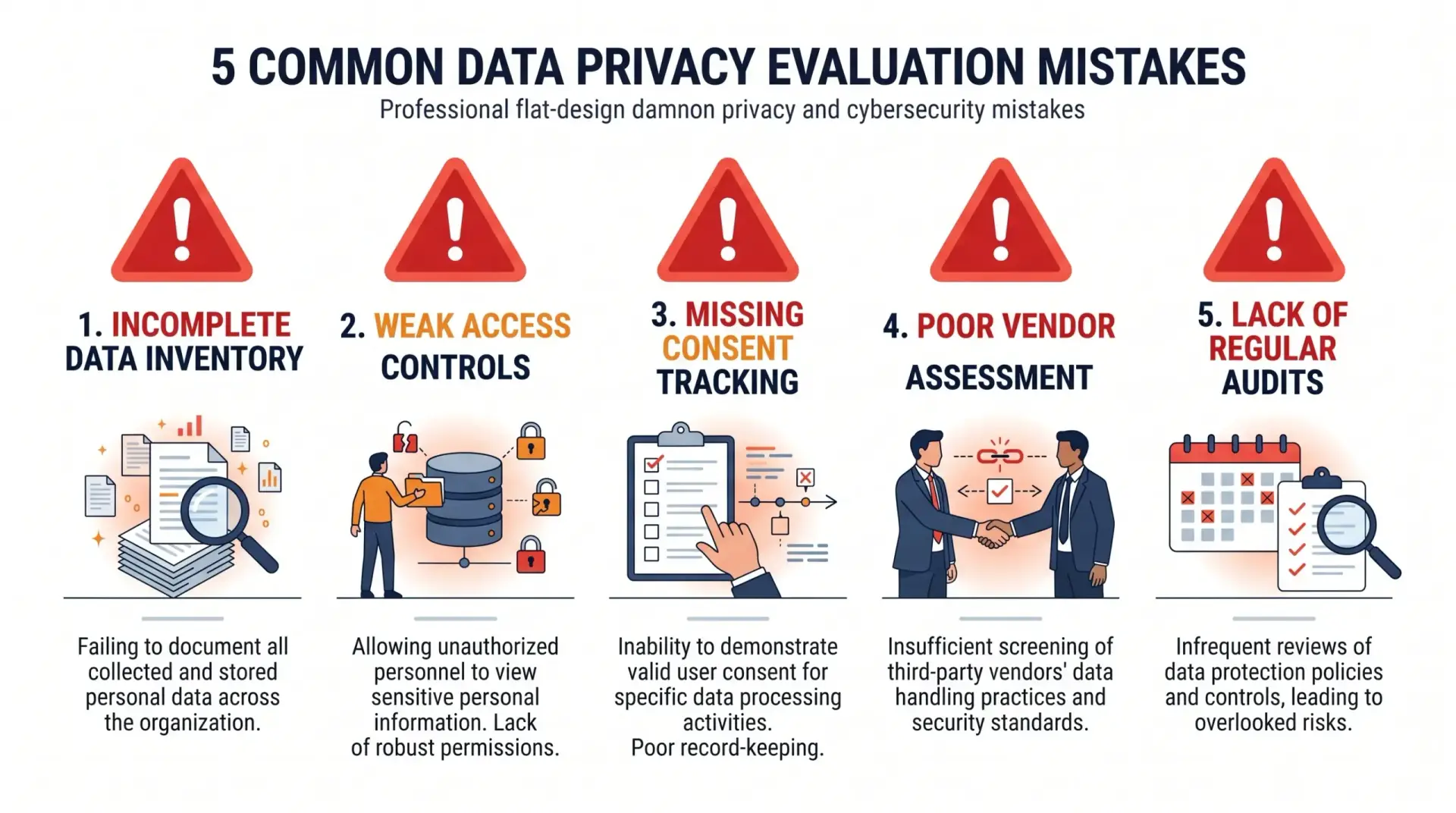
Treating Privacy Policies as a Substitute for Evaluation
A published policy means nothing if the underlying practices do not match it. Regulators and auditors look at what is actually happening with data, not what your website says about it. Evaluate the real process, not the documentation.
Skipping Vendor and Third-Party Assessments
Many organizations focus entirely on their internal systems and ignore third-party tools and service providers. If your vendor experiences a breach involving your users’ data, your organization shares the liability. Always assess how partners handle every piece of data you share with them.
Failing to Involve Legal and Compliance Teams
Data privacy evaluation is not a purely technical exercise. Legal counsel must review compliance gaps. Without legal input, your team may miss jurisdiction-specific requirements that create serious liability — particularly when operating across multiple countries.
Running Evaluations Only After a Problem Occurs
Reactive assessments are always more costly than proactive ones. By the time a breach or complaint forces an evaluation, the damage has already begun. Build regular privacy reviews into your operational calendar — do not wait for a problem to make the case for you.
Ignoring Individual Rights Requests
Privacy laws give individuals the right to access, correct, delete, and port their personal data. Failing to maintain a functioning process for these requests is a compliance failure that regulators actively pursue. Test your rights request process as a standard part of every evaluation cycle.
Overlooking Shadow IT and Unauthorized Apps
Employees regularly use personal tools, free browser extensions, and cloud services that were never approved by IT. These tools often process sensitive organizational data with no oversight, no Data Processing Agreement, and no controls. Your evaluation must include a scan for shadow IT.
Myths vs. Facts About Data Privacy Evaluation
| Myth | Fact |
|---|---|
| Only large enterprises need to evaluate data privacy | Any organization that collects personal data has legal obligations and exposure, regardless of size. SMEs face the same fines under GDPR as large corporations. |
| A privacy policy document is enough | A policy documents your intentions. An evaluation checks whether your actual practices match those intentions. Both are required. |
| GDPR only applies to companies based in the EU | GDPR applies to any organization anywhere in the world that processes the personal data of EU residents. Your location is irrelevant. |
| Encryption alone guarantees data privacy | Encryption protects data in transit and at rest, but data can still be misused, over-collected, or shared improperly. Encryption is one layer, not a complete solution. |
| Privacy evaluation is a one-time task | Data practices, regulations, threats, and technology all change. Evaluations must be repeated on a defined schedule to remain relevant and effective. |
| If you have never had a breach, your privacy practices are fine | Most breaches go undetected for weeks or months. The absence of a known incident is not evidence of good privacy practices. Regular evaluation is how you find out. |
| Compliance equals privacy | Meeting the minimum legal standard does not mean you are protecting people well. Compliance is a floor, not a ceiling. Strong privacy programs go beyond legal minimums. |
Expert Tips from a Cybersecurity Analyst
Based on 11 years reviewing privacy programs across healthcare, finance, retail, and technology sectors, these are the recommendations that make the biggest real-world difference.
💡 Start with what you cannot see. The most dangerous data is the data you do not know you are collecting. Shadow IT — tools employees use without IT approval — often processes sensitive data with no oversight, no contracts, and no controls. Run a shadow IT discovery scan at the start of every evaluation.
💡 Use an established baseline framework. The NIST Privacy Framework provides a structured foundation for organizations of all sizes. It organizes privacy activities across five functions: Identify, Govern, Control, Communicate, and Protect. Using a recognized framework prevents important areas from being overlooked and makes your evaluation defensible to regulators.
💡 Test your deletion process, not just your collection process. Most organizations can add data efficiently. Many cannot reliably delete it when required. Run a test: submit a deletion request for a test record and verify it is actually removed from all systems — including backups, archives, analytics platforms, and third-party tools.
💡 Review browser and app permissions regularly. The data privacy exposure from mobile apps and browser extensions is consistently underestimated. Review every permission granted to every tool your organization uses. Remove tools that request more access than they need to function.
💡 Document everything without exception. An evaluation that is not documented did not happen from a regulatory standpoint. Keep complete records of what you reviewed, what you found, what actions you took, and when you took them. This documentation is your primary defense in a regulatory inquiry.
💡 Check how you handle the Reddit question. Ask yourself: if a privacy researcher asked about your data practices on a public forum, could you explain and defend every choice you make? Privacy-conscious users actively discuss and evaluate services. Organizations that can answer confidently are the ones with genuinely strong practices.
People Also Ask
How do you know if a company is protecting your data?
Check for a clear and current privacy policy. Review the company’s history of data breaches using public databases. Look for third-party certifications like SOC 2 Type II or ISO 27001. Test their data subject rights process by submitting an access request. You can also search for any enforcement actions taken against them by regulators like the FTC or EU data protection authorities.
What is a Privacy Impact Assessment?
A Privacy Impact Assessment (PIA) is a structured process used to identify and reduce privacy risks before a new system, project, or data-processing activity begins. It documents what personal data will be collected, what risks that creates for individuals, and how those risks will be managed or removed before the system goes live.
How often should you evaluate data privacy?
At minimum, once per year. You should also conduct an evaluation whenever you introduce new systems, significantly change your data practices, enter new regulatory jurisdictions, or experience any incident involving personal data. Organizations in high-risk sectors like healthcare and financial services typically conduct reviews more frequently — some quarterly.
What laws govern data privacy evaluation requirements?
Common laws include GDPR for EU data, CCPA and CPRA for California consumer data, HIPAA for US healthcare information, FERPA for US student data, and sector-specific regulations in finance, telecommunications, and children’s services. The FTC also enforces general data privacy standards for US businesses under its unfair practices authority. Requirements vary significantly by jurisdiction and industry.
Can individuals evaluate the data privacy of apps they use?
Yes. Review the app’s privacy policy before installing. Check which permissions it requests and compare them against the functionality it provides. Search app store reviews and security research publications for reported incidents. Use browser privacy extensions to see what data is being tracked. Look up the developer on data broker opt-out registries. Even basic research reveals significant differences between how apps describe their practices and what they actually do.
Why is data privacy important for small businesses?
Small businesses face the same legal obligations as large enterprises when they collect personal data, but often have fewer resources to respond to a breach or regulatory inquiry. A single fine under GDPR or a class action lawsuit can be financially devastating for a small organization. Regular evaluation helps small businesses stay compliant without needing a full-time privacy team.
Frequently Asked Questions
What does it mean to evaluate data privacy?
To evaluate data privacy means conducting a structured review of how an organization or system collects, stores, uses, and shares personal information. The evaluation compares stated practices against actual practices, identifies compliance gaps and security risks, and prioritizes corrective actions based on the severity of each finding.
What is the difference between a PIA and a DPIA?
A Privacy Impact Assessment (PIA) is a general risk assessment tool that can be used for any new project or system involving personal data. A Data Protection Impact Assessment (DPIA) is a specific legal requirement under GDPR, mandated for processing activities that are likely to result in high risk to individuals. All DPIAs follow a PIA structure, but not every PIA meets the threshold requiring a DPIA under GDPR.
What framework should I use to evaluate data privacy?
The NIST Privacy Framework is widely recommended for organizations of any size and is freely available. For EU operations, GDPR’s accountability requirements provide a practical structure. ISO 29100 offers an international privacy principles standard. In the US healthcare sector, HIPAA’s Security Risk Analysis methodology provides a required framework. For most organizations, starting with NIST and layering in jurisdiction-specific requirements is the most efficient approach.
What happens if a company fails a data privacy evaluation?
Failing an evaluation reveals gaps that must be addressed through a formal remediation plan. If those gaps violate applicable laws and a regulator discovers them — through a complaint, a breach notification, or a scheduled audit — the organization may face significant fines, public enforcement actions, or court-ordered changes to its data practices. The FTC can pursue civil penalties for US companies engaging in unfair or deceptive data practices.
Is data privacy evaluation required by law?
In many cases, yes. GDPR mandates DPIAs for high-risk processing activities. HIPAA requires covered entities and business associates to conduct documented risk analyses as a core compliance requirement. CCPA requires organizations to respond to data subject rights requests on strict timelines, which requires knowing exactly where data lives. Even where a formal evaluation is not explicitly required, industry standards and regulatory expectations make regular evaluation a practical necessity.
How is data privacy evaluation different from a cybersecurity audit?
A cybersecurity audit focuses on technical controls — whether your systems are properly configured, patched, and protected against attack. A data privacy evaluation focuses on what data you collect and why, whether your collection is legally justified, whether you are meeting individuals’ rights, and whether your data practices match your stated policies. Cybersecurity is about keeping attackers out. Data privacy evaluation is about ensuring responsible data use from the inside out. Both are necessary and should be conducted separately.
Key Takeaways
- Evaluating data privacy means reviewing how personal information is collected, stored, used, and shared — and comparing stated practices against reality.
- Why is data privacy important? Because breaches cause financial loss, regulatory penalties, and long-term loss of customer trust.
- There are five main types of assessments: PIA, DPIA, Third-Party Vendor Review, Privacy Program Effectiveness Review, and Incident-Triggered Review.
- Follow the nine-step process: map data, identify laws, review policies, check consent, assess storage, test incident response, score risks, plan remediation, and repeat.
- Common mistakes include skipping vendor reviews, treating policy documents as a substitute for practice, and failing to test individual rights processes.
- The NIST Privacy Framework and GDPR compliance structure provide strong starting frameworks for evaluations of any scale.
- Privacy evaluation is not a one-time task. It must be repeated regularly and triggered by significant changes in systems, practices, or regulations.
- Documentation is critical. An undocumented evaluation carries no weight with regulators or in legal proceedings.
Conclusion
Knowing how to evaluate data privacy is not just a compliance checkbox. It is how you find the problems before someone else does — before a regulator, a breach notification, or a news headline forces the conversation.
Personal data is actively targeted. Organizations that collect it without regularly evaluating how it is protected will face consequences. That might come as a regulatory fine, a breach lawsuit, or the quiet loss of customer trust that never fully returns. None of those outcomes are acceptable when the alternative is a structured, proactive evaluation process.
The good news is that a proper evaluation is straightforward when you follow a structured process. Map your data. Check your compliance. Review your policies. Test your controls. Fix what you find. Then set a schedule and do it again.
To take the next step in protecting your systems, read our guide on how to do a website safety check — a practical method to identify security and privacy risks on any site before you trust it with personal information. You can also review our guide on how to fix Chrome network access errors, which often signal browser-level configuration issues that can affect privacy and data routing in your environment.
Use the checklist in this guide as your starting point. Run your first evaluation, document your findings, and build a regular schedule for ongoing reviews. Your data — and the people who trust you with it — deserve that level of attention.