
Your AC is most likely not turning on because of a tripped circuit breaker, wrong thermostat settings, dead thermostat batteries, a clogged air filter, a tripped float switch, or a failed capacitor. Start by checking your breaker panel, then your thermostat, then your air filter — in that order. Most AC startup failures come down to one of these five causes and can be fixed without a technician in under 15 minutes.
What Controls Whether Your AC Turns On
Before running through fixes, it helps to understand what your AC system needs to start up successfully.
A standard central air conditioning system has four key requirements to turn on:
- Power supply — Electricity must reach both the indoor air handler and the outdoor condenser unit.
- Thermostat signal — The thermostat must be set to “Cool” mode, with a target temperature lower than the current room temperature.
- Safety systems clear — Float switches, high-pressure switches, and safety cutoffs must not be triggered.
- Working components — The capacitor, contactor, compressor, and blower motor must all be functional.
If any one of these conditions is not met, the AC will not turn on. The good news is that the first three can almost always be checked and fixed at home.
Why Is My AC Not Turning On? Top Causes
Here is a breakdown of the most common reasons an AC unit refuses to start, ranked from most to least frequent.
| Cause | DIY Fix? | Time to Fix | Frequency |
|---|---|---|---|
| Tripped circuit breaker | Yes | 5 minutes | Very common |
| Wrong thermostat settings | Yes | 2 minutes | Very common |
| Dead thermostat batteries | Yes | 5 minutes | Common |
| Clogged air filter | Yes | 10 minutes | Common |
| Tripped float switch | Sometimes | 10–20 minutes | Common |
| Outdoor disconnect switch off | Yes | 2 minutes | Moderate |
| Failed capacitor | No | Professional | Moderate |
| Failed contactor | No | Professional | Moderate |
| Faulty control board | No | Professional | Less common |
| Refrigerant leak | No | Professional | Less common |
| Compressor failure | No | Professional | Rare |
Step-by-Step Troubleshooting Fixes
Fix 1: Check the Circuit Breaker
This is always the first place to look when your AC is not turning on.
How to do it:
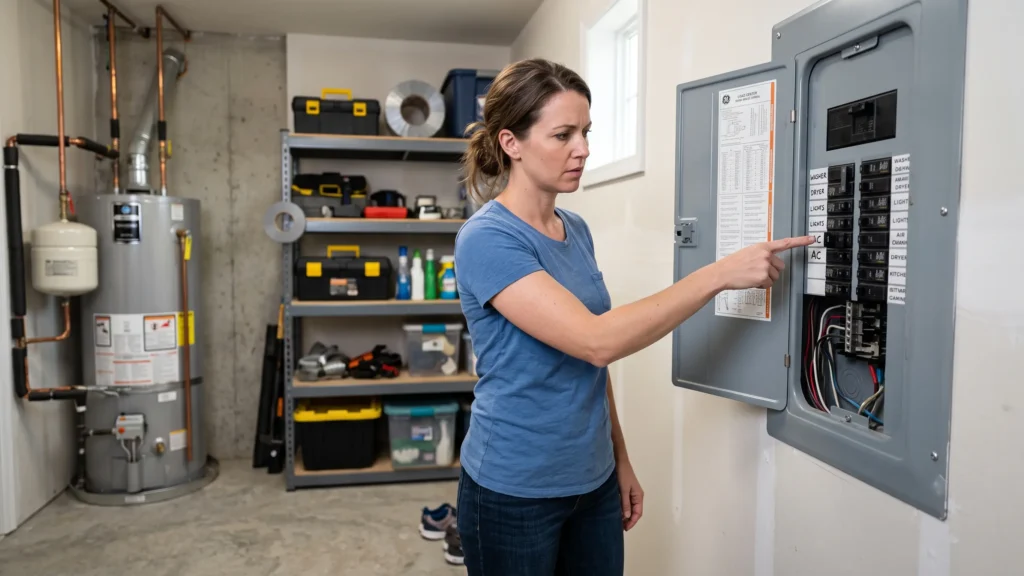
- Go to your home’s main electrical panel — usually in a garage, basement, hallway, or utility room.
- Find the breaker labeled “AC,” “Air Conditioner,” “HVAC,” or “Furnace.” Some homes have two breakers for the system: one for the air handler (indoor) and one for the condenser (outdoor).
- Look at the switch position. If it is pointing to the center or toward “OFF,” it has tripped.
- Flip the breaker fully to “OFF,” then back to “ON.”
- Wait 5 minutes before trying to turn on the AC.
Important: If the breaker trips again immediately after you reset it, stop. A breaker that keeps tripping indicates a wiring fault, a failing compressor, or a short circuit. Do not keep resetting it — call a licensed electrician or HVAC technician.
Fix 2: Check Thermostat Settings
Incorrect thermostat settings are one of the top reasons an AC appears broken when it is actually fine.
How to do it:
- Go to your thermostat and check that the mode is set to “Cool” — not “Heat,” “Fan Only,” or “Off.”
- Check the set temperature. It must be at least 2–3 degrees lower than the current indoor temperature. If your room is 74°F and the thermostat is set to 74°F, the AC has no reason to turn on.
- Make sure the fan is set to “Auto,” not “On.” The “On” setting runs the fan continuously without cooling.
- If the display is dim or blank, replace the batteries even if you think they are fine.
Pro tip from the field: Many “broken AC” calls I receive in summer turn out to be a thermostat accidentally switched to “Heat” by a family member. Always check this first — it takes 30 seconds.
Fix 3: Replace Thermostat Batteries
Even if the screen is on, low batteries can cause inconsistent communication between the thermostat and the AC unit.
How to do it:
- Remove the thermostat cover (most snap off or slide off).
- Look for AA or AAA batteries in a compartment on the back.
- Replace with fresh batteries.
- Snap the cover back, set the thermostat to “Cool,” and lower the set temperature.
- Wait 1–2 minutes to see if the system responds.
Replace thermostat batteries once a year as part of routine home maintenance — the same time you change smoke detector batteries works well.
Fix 4: Check and Replace a Clogged Air Filter
A severely clogged air filter restricts airflow to the point where the AC’s internal safety sensors shut the system down to prevent overheating. The system will not restart until it cools down — and if the filter stays clogged, it will just shut off again.
How to do it:
- Find your air filter. It is usually located in the indoor air handler unit or behind a return air vent on a wall or ceiling.
- Slide out the filter and hold it up to light. If you cannot see light through it, it is time to replace it.
- Note the size printed on the filter frame (for example, 16x20x1).
- Replace with a new filter of the same size and MERV rating.
- Slide it back in with the arrow on the frame pointing toward the air handler unit.
- Turn the system back on.
Replace your air filter every 30–90 days depending on usage, pets, and dust levels in your home. A clean filter is the single easiest way to prevent most AC problems.
Fix 5: Check the Outdoor Disconnect Switch
Most outdoor condenser units have a dedicated disconnect box mounted on the exterior wall nearby. This is a safety shutoff that can be accidentally turned off.
How to do it:
- Walk to your outdoor condenser unit.
- Look for a grey or black metal box mounted on the wall, usually within a few feet of the unit.
- Open the box. Inside you will see either a pull-out block, a switch, or fuses.
- If the pull-out block is removed or flipped upside down, reinsert it correctly.
- If there is a switch, make sure it is in the “On” position.
If the disconnect box contains fuses, visually inspect them for signs of damage — a blackened fuse or a broken wire inside the glass casing means the fuse has blown and needs replacement.
Fix 6: Check the Condensate Drain Float Switch
Modern AC systems have a safety float switch in the condensate drain pan. When the drain line clogs and water backs up into the pan, this switch cuts off power to the unit to prevent water damage.
This is one of the most overlooked causes of AC shutdown, especially in humid climates.
How to spot it:
- The AC was working fine and then stopped suddenly.
- You notice standing water near the indoor air handler.
- The system powers on but immediately shuts off.
How to do it:
- Locate the indoor air handler unit — often in a closet, attic, or utility room.
- Look for a drain pan under the evaporator coil. If water is sitting in the pan, the drain line is clogged.
- Find the white PVC drain line. Pour one cup of distilled white vinegar into the access port to clear algae buildup.
- If water does not drain after a few minutes, use a wet/dry vacuum to suction the clog from the exterior drain outlet.
- Once the pan is empty and draining, the float switch will reset and the AC should turn back on.
Pour a cup of vinegar down the condensate drain line every month during cooling season to prevent future clogs.
Fix 7: Press the AC Reset Button
Some AC units have a built-in reset button on the outdoor condenser unit. A power surge, overheating event, or temporary fault can trip this button without affecting the circuit breaker.
How to do it:
- Go to your outdoor condenser unit.
- Look along the bottom edge or side for a small red or yellow button labeled “Reset.”
- Press and hold it for 3 seconds.
- Return inside and try turning on the AC.
Not all units have a reset button. If yours does not, skip this step.
Advanced Causes That Need a Pro
If you have worked through all seven fixes above and your AC is still not turning on, the problem is likely an internal component failure. These require professional diagnosis and repair.
Failed Capacitor
The capacitor is a cylindrical component inside the outdoor unit that provides the electrical boost needed to start the compressor and fan motors. When a capacitor fails, you may hear a humming or clicking sound as the unit tries to start but cannot.
Signs of a bad capacitor:
- A humming sound from the outdoor unit with no actual startup
- The fan is not spinning even though the unit has power
- Frequent short-cycling (starting and stopping quickly)
Capacitors store a high-voltage electrical charge even when the power is off. Do not attempt to test or replace a capacitor yourself — this is a job for a licensed HVAC technician.
Failed Contactor
The contactor is an electrical switch inside the outdoor unit that connects power from the disconnect to the compressor and fan motor when the thermostat calls for cooling. A worn or burned contactor will prevent the outdoor unit from starting even if the indoor air handler is running.
Signs of a bad contactor:
- The indoor fan runs but the outdoor unit does not start
- You hear a chattering or buzzing from the outdoor unit
- The AC worked intermittently before stopping completely
Refrigerant Leak
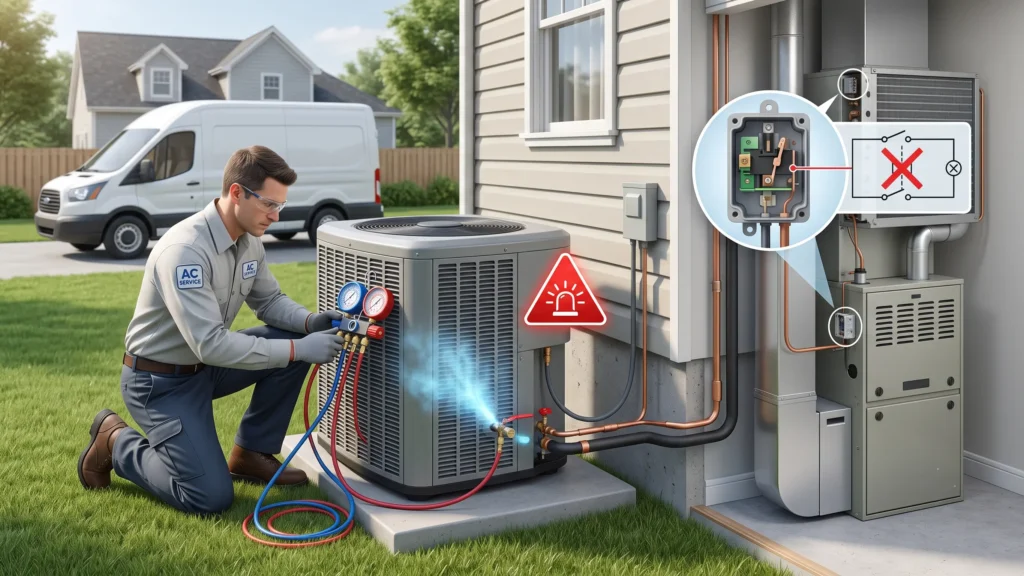
If your system has lost refrigerant due to a leak, it may trigger a low-pressure safety switch that prevents the unit from starting — this protects the compressor from damage.
Signs of a refrigerant leak:
- Hissing or bubbling sounds near refrigerant lines
- Ice buildup on the evaporator coil or outdoor unit
- The AC runs but produces little to no cooling
- Higher electricity bills with no change in usage
Only EPA-certified technicians can legally handle and recharge refrigerant. Do not attempt this repair yourself.
Control Board Failure
The control board is the electronic brain of your AC system. A power surge, lightning strike, or age-related failure can damage the board, preventing the system from responding to thermostat signals at all.
Signs of control board failure:
- No response from the system despite correct settings
- Erratic behavior — random shutoffs, incorrect modes
- System passed all basic checks but still will not start
Control board replacement requires professional diagnosis to confirm the board is the actual cause, since symptoms overlap with several other issues.
Outside Unit Not Turning On — Specific Fixes
A common scenario is the indoor air handler blowing air but the outside AC unit not turning on. This specific pattern usually points to one of four causes:
- No power to the outdoor unit — Check the outdoor disconnect box. The outdoor breaker may be tripped independently from the indoor breaker on dual-breaker systems.
- Failed capacitor — The most common cause when the indoor unit is working but the outdoor unit hums without starting.
- Failed contactor — The indoor unit signals but the outdoor unit does not receive the command to start.
- High-pressure switch tripped — This can happen when the outdoor condenser is buried in debris, leaves, or dirt and cannot release heat. Clean around the unit and try again after 30 minutes.
If the outdoor unit makes a humming sound but does not spin, turn it off immediately to prevent compressor damage. Call an HVAC technician — this almost always means a capacitor or contactor issue.
AC Not Turning On After Winter — Seasonal Startup Issues
If your AC sat unused through fall and winter, there are specific startup issues to be aware of.
Common seasonal causes:
- Debris accumulation in the outdoor unit — Leaves, dirt, nesting material, and small animals can block airflow or damage wiring. Clear the area around the unit and use a hose to gently rinse the condenser fins before the first startup of the season.
- Rodent damage to wiring — Mice and squirrels sometimes chew through wiring inside the outdoor unit during winter. Inspect accessible wiring for damage before startup.
- Corroded electrical connections — Moisture over winter can cause corrosion on electrical contacts. A technician can clean and inspect these during a seasonal tune-up.
- Thermostat still set to “Heat” — This is extremely common after winter. Simply switch it to “Cool.”
Seasonal startup checklist:
- Switch thermostat to “Cool” mode
- Replace the air filter
- Clear debris from around the outdoor unit
- Inspect the disconnect box
- Run a test cycle on a mild day before relying on it during a heat wave
Troubleshooting Checklist
Use this checklist before calling a technician.
Circuit breaker checked and reset if tripped
Indoor air handler breaker checked separately
Outdoor disconnect switch confirmed “On”
AC reset button pressed (if unit has one)
Thermostat set to “Cool” mode
Thermostat set temperature lower than current room temperature
Thermostat batteries replaced
Air filter checked and replaced if clogged
Condensate drain pan inspected for standing water
Condensate drain line cleared if clogged
Outdoor unit area cleared of debris
Outdoor unit inspected for visible damage or ice
If all items above are checked and the AC still does not turn on, call a licensed HVAC technician.
Decision Tree: What to Check First
AC Not Turning On
│
├── Is there power at the thermostat?
│   ├── No → Replace batteries / check breaker
│   └── Yes → Continue
│
├── Is the thermostat set to "Cool" with temp below room temp?
│   ├── No → Adjust settings and wait 2 minutes
│   └── Yes → Continue
│
├── Is the circuit breaker in the "On" position?
│   ├── No → Reset breaker (if it re-trips, call a pro)
│   └── Yes → Continue
│
├── Is the air filter clean?
│   ├── No → Replace filter and wait 15 minutes for system to reset
│   └── Yes → Continue
│
├── Is the condensate pan overflowing?
│   ├── Yes → Clear the drain line and let pan empty
│   └── No → Continue
│
├── Is the outdoor disconnect switch "On"?
│   ├── No → Turn it on
│   └── Yes → Continue
│
└── Unit still won't start → Call a licensed HVAC technician
    (likely capacitor, contactor, control board, or refrigerant issue)
Common Mistakes Homeowners Make
1. Resetting the breaker over and over A breaker that trips repeatedly is telling you something is wrong with the electrical system or the compressor. Resetting it repeatedly can cause a fire or serious equipment damage.
2. Ignoring a dirty air filter for months A clogged filter causes far more than startup failures — it can freeze evaporator coils, overheat the blower motor, and reduce the lifespan of the entire system.
3. Turning the thermostat all the way down to make the AC cool faster Air conditioning systems cool at a fixed rate. Setting the thermostat to 60°F when you want 72°F will not cool the room faster — it will just run the system longer and may cause overcooling or freezing issues.
4. Trying to fix a capacitor or contactor without training Capacitors hold a lethal electrical charge even after power is disconnected. This is not a DIY repair.
5. Forgetting to wait the 3-minute rule After any power interruption, wait at least 3 minutes before restarting your AC. This allows refrigerant pressures to equalize and protects the compressor from starting under unequal pressure conditions.
6. Skipping seasonal maintenance Most AC startup failures in summer could be prevented by a spring tune-up that includes cleaning the coils, checking refrigerant levels, testing the capacitor, and clearing the drain line.
Myths vs. Facts
| Myth | Fact |
|---|---|
| If the AC makes noise, it’s working fine | A humming sound with no startup usually means a failed capacitor |
| Turning the thermostat very low cools faster | AC cools at a fixed rate — set temperature only affects when it stops |
| You can add refrigerant yourself | Only EPA-certified technicians can legally handle refrigerant |
| A tripped breaker always means an electrical problem | Breakers also trip from normal power surges — one reset is fine; repeated trips are not |
| A new AC never needs maintenance | All AC systems need annual maintenance regardless of age |
| If the indoor fan works, the whole system is fine | The outdoor compressor can fail independently while the indoor blower runs |
| Bigger AC = better cooling | An oversized unit short-cycles, causing humidity problems and premature wear |
Expert Tips from 12 Years of HVAC Troubleshooting
Over more than 12 years of diagnosing AC systems across Texas, I’ve seen the same issues come up time and time again. Here are the things I always tell homeowners:
“Check the condensate drain before you assume the worst.” In humid climates, a clogged drain is the number one cause of sudden AC shutdown that homeowners never suspect. The system appears completely dead, but clearing a $2 drain line brings it right back.
“Date your air filter.” Write the date you installed it on the side of the filter with a marker. You won’t have to guess when it was last changed.
“Buy a spare filter.” Keep a replacement filter in your utility room. When you check your current filter and find it clogged, you can replace it immediately instead of running to the hardware store in 95°F heat.
“Do not run the AC with ice on the lines.” If you see ice forming on the refrigerant lines or indoor coil, turn the system off and let it thaw completely. Running a frozen system can permanently damage the compressor. Switch the thermostat to “Fan Only” to speed up the thawing process.
“Plan a spring tune-up, not a summer emergency call.” Schedule an HVAC maintenance visit in April or early May — before the first heat wave. You’ll get better availability, lower rates, and peace of mind before the season starts.
When to Call a Professional
Call a licensed HVAC technician immediately if:
- The circuit breaker trips again right after you reset it
- You hear a loud humming, grinding, or screeching from the outdoor unit
- You see ice on the refrigerant lines or outdoor coil
- You smell burning or electrical odors from the unit
- The AC worked intermittently before stopping completely
- Standing water is around the indoor unit after clearing the drain
- Your AC is older than 12–15 years and shows signs of multiple issues
For most non-emergency situations, call during regular business hours to avoid after-hours emergency rates.
How to Prevent AC Startup Failures
These simple habits will prevent the vast majority of AC problems before they happen.
Change the air filter regularly. Every 30 days for homes with pets or allergies; every 90 days for typical usage.
Clear the outdoor unit seasonally. Keep at least 18–24 inches of clearance around all sides of the condenser unit. Trim back vegetation and remove any debris after storms.
Schedule annual professional maintenance. A pre-season tune-up covers capacitor testing, refrigerant level checks, coil cleaning, drain line clearing, and electrical connection inspection — all the things that cause startup failures.
Pour vinegar down the drain line monthly. During cooling season, pour one cup of distilled white vinegar down the condensate drain line access port every month. This prevents algae and mold from clogging the line.
Test the system before summer peaks. Run your AC for a full test cycle in late spring, before temperatures hit their highest. Finding a problem in May is far better than discovering it during a July heat wave.
Replace your thermostat batteries annually. Do this every year, regardless of whether the display appears dim. Weak batteries can cause intermittent communication failures that mimic larger system issues.
People Also Ask
Why is my AC not turning on but the thermostat is on?
If your thermostat is on but the AC will not start, the most likely causes are a tripped circuit breaker, a triggered float switch due to a clogged condensate drain, a failed capacitor in the outdoor unit, or a bad contactor. Start by checking the breaker panel, then inspect the condensate drain pan for standing water. If both are clear, the issue is likely an internal component that requires a professional.
Why would an AC suddenly stop turning on?
A sudden shutdown usually points to one of four things: a safety switch was triggered (float switch or high-pressure switch), the circuit breaker tripped due to a power surge, the capacitor failed, or the system reached a thermal shutdown state due to overheating from a clogged filter or blocked condenser. Work through the troubleshooting checklist in order before calling for service.
What to do if AC is not turning on?
Start with the five basics: (1) check the circuit breaker and reset if tripped, (2) verify thermostat settings are set to “Cool” with the temperature below the room temperature, (3) replace thermostat batteries, (4) inspect and replace a clogged air filter, and (5) check the condensate drain pan for overflow. If none of these steps resolve the problem, call a licensed HVAC technician.
Why is my outside AC unit not turning on but inside is?
When the inside air handler works but the outside condenser does not, the most common culprits are a failed capacitor, a worn contactor, or a loss of power specifically to the outdoor unit. Check the outdoor disconnect box first. If power is confirmed and the outdoor unit hums but does not spin, turn it off immediately and call a technician — continued operation without the fan running can burn out the compressor.
How do I reset my AC unit that won’t turn on?
To reset your AC: (1) turn off the thermostat, (2) go to the electrical panel and flip the AC breaker to “OFF,” (3) wait 30 seconds, (4) flip the breaker back to “ON,” (5) wait 3 minutes, (6) set the thermostat back to “Cool.” If your outdoor unit has a reset button, press and hold it for 3 seconds before turning the system back on.
FAQ
How long does an AC take to turn on after being reset?
After resetting the breaker or pressing the reset button, wait at least 3 minutes before turning the system on at the thermostat. This is called the 3-minute rule, and it allows refrigerant pressures in the system to equalize. Starting the compressor before pressures equalize can cause permanent damage.
Can a dirty air filter prevent the AC from turning on?
Yes. A severely clogged air filter restricts airflow enough to cause the system’s internal safety sensors to shut the unit down. The system will not restart until it cools down. Replace the filter, then wait 15–30 minutes before attempting to restart the AC.
My AC hums but won’t start — what does that mean?
A humming sound with no actual startup almost always indicates a failed start capacitor. The motor is receiving power and trying to start, but it cannot generate enough torque to get moving. Turn the system off immediately to avoid burning out the motor, and call an HVAC technician to replace the capacitor.
Is it safe to reset a tripped AC breaker myself?
Yes — resetting a tripped breaker once is safe and appropriate. If the breaker trips again right away, stop resetting it. A breaker that trips repeatedly indicates a serious electrical fault or compressor issue that must be diagnosed by a professional before the breaker is reset again.
Why does my AC not turn on when it’s very hot outside?
On extremely hot days, the outdoor condenser unit must work harder to release heat. If the outdoor temperature is high enough and the condenser coils are dirty or airflow is restricted, the system can trip a high-pressure safety switch. Clear debris from around the outdoor unit, let it rest for 30 minutes in the shade if possible, and then try again. If this happens regularly on hot days, the condenser coils likely need professional cleaning.
How much does it cost to fix an AC that won’t turn on?
The cost depends heavily on the cause. Thermostat battery replacement: under $10. Air filter replacement: $10–$30. Capacitor replacement: $150–$350. Contactor replacement: $150–$400. Control board replacement: $300–$600. Refrigerant recharge: $200–$600. Compressor replacement: $800–$2,500+. Getting a diagnosis first — typically $75–$150 for a service call — is the best way to understand what you are actually dealing with before committing to a repair.
Should I cover my AC unit in winter?
Covering the top of the outdoor unit with a breathable cover to block falling debris is fine, but never wrap the entire unit in a solid cover. Full enclosure traps moisture, promotes corrosion, and creates attractive nesting spots for rodents — which can chew through wiring. If you live in an area with mild winters, you can leave the unit uncovered entirely.
Key Takeaways
- The five most common causes of an AC not turning on are: tripped breaker, wrong thermostat settings, dead batteries, clogged air filter, and a triggered float switch.
- Always check these five things before calling a technician — most startup failures can be resolved at home in under 15 minutes.
- A breaker that trips again immediately after reset signals a serious electrical issue — do not keep resetting it.
- When the outdoor unit hums but does not spin, turn it off immediately to protect the compressor and call a technician.
- A clogged condensate drain is one of the most overlooked causes of AC shutdown, particularly in humid climates.
- Capacitor replacement, contactor replacement, refrigerant handling, and control board repair all require a licensed HVAC technician.
- Annual professional maintenance in spring is the most effective way to prevent summer startup failures.
- The 3-minute rule protects your compressor — always wait at least 3 minutes after any power interruption before restarting.
Conclusion
When your AC is not turning on, the problem is almost always one of five fixable causes: a tripped breaker, wrong thermostat settings, dead batteries, a clogged air filter, or a blocked condensate drain. These are all things you can check and correct in minutes, without any special tools or training.
Work through the troubleshooting steps in this guide in order. If you clear all the basic checks and the system still refuses to start, you are looking at an internal component failure — most likely a capacitor, contactor, or control board — and that is when it is time to call a licensed HVAC technician.
The best way to avoid this situation entirely is consistent, simple maintenance: change your air filter on schedule, clear debris from the outdoor unit seasonally, pour vinegar down the drain line monthly, and schedule a professional tune-up every spring before the cooling season begins.