



What is AI Bubble? An AI bubble is a period of excessive market speculation where artificial intelligence companies are valued far beyond what their actual revenues or profits justify — driven by hype, fear of missing out, and massive capital investment. If investor expectations outpace reality and sentiment shifts, this bubble can “burst,” triggering sharp stock market declines, job losses in the tech sector, and a broader financial correction. As of 2026, the debate over whether the AI bubble has already started deflating — or is still inflating — is one of the most pressing questions in global finance.
Introduction: Are We in an AI Bubble Right Now?
I’ve been watching financial markets closely over the past few years, and I can tell you — nothing has generated more heated debate than the question of the AI bubble.
On one side, you have investors and tech executives arguing that AI is a once-in-a-generation revolution, easily worth the trillions being poured into it. On the other, you have economists and analysts sounding alarm bells that look eerily familiar — very much like the dot-com bubble of 2000, just with more zeros.
The truth, as I’ll walk you through in this guide, is more nuanced than either camp admits.
Whether you’re an investor, a tech professional, a student, or just someone trying to make sense of the headlines, this article will give you a clear, honest, and complete picture of:
- What the AI bubble actually is
- How it formed
- The warning signs that it might burst
- What happens if it does
- And how different it really is from the dot-com crash
Let’s dig in.
What Is the AI Bubble? (Full Definition)
An AI bubble is a speculative market phenomenon in which the valuations of artificial intelligence companies — and AI-adjacent businesses — rise far above what their actual business fundamentals can support.
Bubbles form when:
- Investor enthusiasm and hype outpace real-world adoption
- Capital floods into a sector based on future promise, not present profits
- “Fear of missing out” (FOMO) replaces rational analysis
- Companies get valued on vague narratives rather than concrete revenue
In the context of AI, this means that companies like Nvidia, Microsoft, Alphabet, Meta, and dozens of AI startups have seen their stock prices and valuations shoot upward — fueled largely by the belief that AI will eventually generate enormous profits. The key word is eventually.
The problem? Valuations are being priced in today, while revenues are expected to materialize years from now. That gap — between current market price and current economic reality — is the bubble.
How Did the AI Bubble Form? The Origin Story
To understand the AI bubble, you need to understand how it was inflated.
The ChatGPT Moment
When OpenAI launched ChatGPT in late 2022, it became the fastest-growing consumer product in history, reaching 100 million users in under two months. That single event convinced investors, corporate boards, and governments that generative AI was going to be as transformative as the internet — maybe more so.
What followed was a capital stampede.
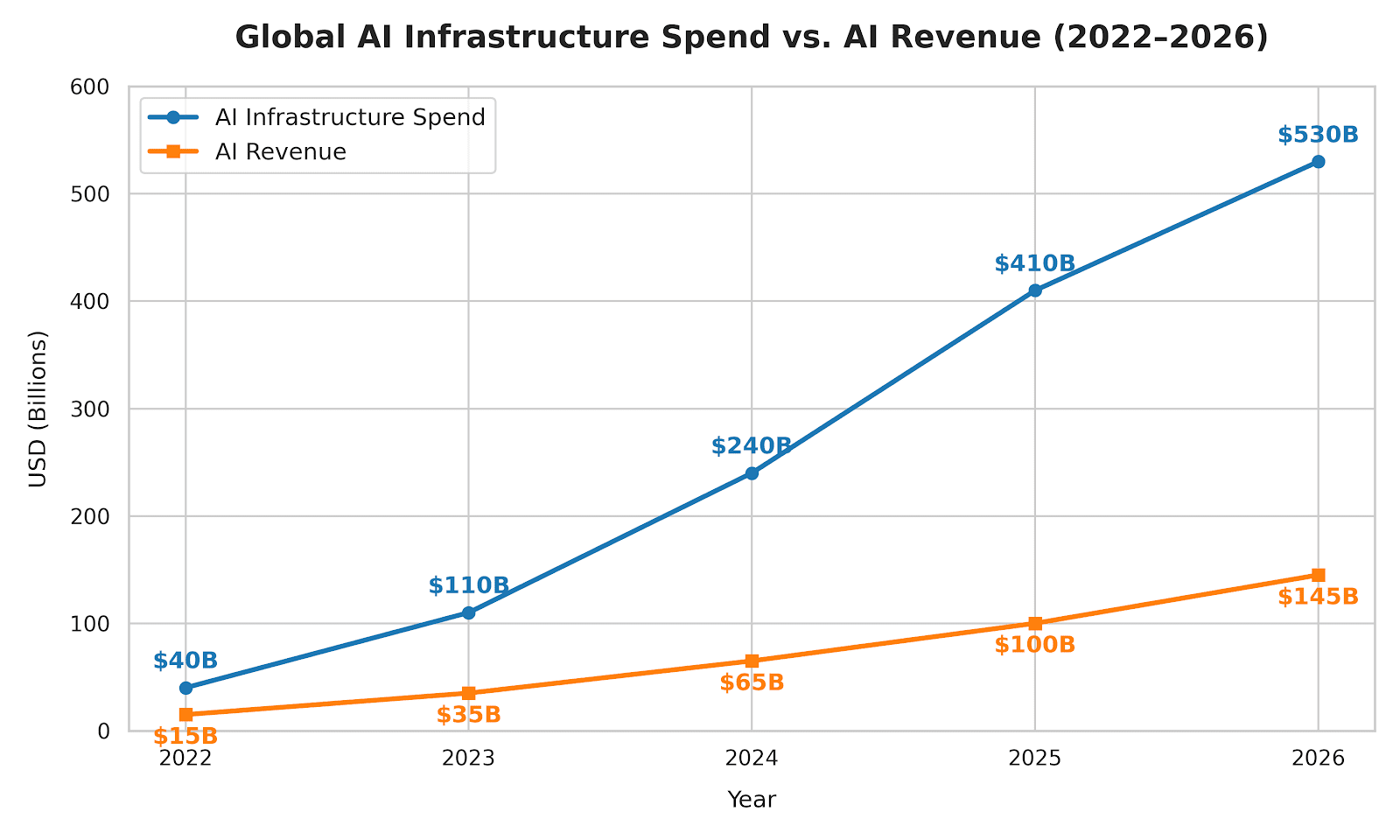
The Numbers That Built the Bubble
The scale of AI investment since 2023 is staggering:
| Metric | Figure |
|---|---|
| Global AI infrastructure investment (2026) | ~$400 billion annually |
| Enterprise AI revenue (2026) | ~$100 billion annually |
| AI capex projected for 2026 (Goldman Sachs) | ~$539 billion |
| VC funding share going to AI startups (early 2025) | 58% of global VC |
| S&P 500 gains driven by AI-related companies (2025) | ~80% |
| Enterprises reporting zero measurable ROI from gen AI | ~95% (MIT research) |
That last row is the one that keeps financial analysts up at night.
Companies are spending hundreds of billions building AI infrastructure — data centers, chips, models — while the actual revenue being generated from AI products remains a fraction of that spend. As one analyst described it, it’s a “capacity bubble”: infrastructure being built far ahead of the utility or revenue it generates.
The Magnificent Seven and Market Concentration
Much of the AI bubble is concentrated in what markets call the “Magnificent Seven” — Apple, Microsoft, Amazon, Alphabet, Meta, Nvidia, and Tesla (sometimes Broadcom takes Tesla’s spot in this list).
The valuations of these companies, fueled by AI narratives, have grown dramatically since 2020. Their combined market capitalization now represents more than a third of the entire S&P 500. That level of market concentration in just seven companies is historically unusual — and historically risky.
Warning Signs: Is the AI Bubble Already Showing Cracks?
I think it’s worth looking honestly at the signals that suggest the bubble is under stress.
1. The DeepSeek Shock (January 2025)
In late January 2025, a Chinese AI startup called DeepSeek released a competitive reasoning model that it claimed had been trained for under $6 million — a tiny fraction of the billions American AI companies spend. The announcement triggered a sharp selloff in AI stocks. Nvidia’s shares dropped 17% in a single day, wiping out hundreds of billions in market value.
The DeepSeek shock crystallized a key fear: what if the enormous capital expenditures being made by Western AI companies don’t actually represent a sustainable competitive advantage?
2. The Revenue Gap
As of 2026, global AI infrastructure investment is approaching $400 billion annually, while enterprise AI revenue sits at around $100 billion. That’s a $300 billion gap between what’s being spent and what’s being earned.
3. Ruchir Sharma’s “Four O’s”
Renowned economist Ruchir Sharma, in an interview with Norges Bank Investment Management CEO Nicolai Tangen, argued that the AI boom checks every box on his four-part bubble checklist — what he calls the “Four O’s”:
- Overinvestment — AI and tech spending is surging at rates comparable to the dot-com era
- Overvaluation — Major AI players are approaching bubble territory on long-term earnings metrics
- Over-ownership — Americans hold a record share of wealth in equities, most of it AI-related
- Over-leverage — Big Tech companies like Meta, Amazon, and Microsoft have become among the largest issuers of new debt to fund AI expansion
4. Adoption Stalling
While 88% of companies report using AI in some form (McKinsey), real adoption at scale is slower than projected. Employee anxiety about job displacement is one factor. Practical integration challenges are another. The technology is powerful, but turning it into consistent business value has proven harder than the headlines suggest.
5. Sam Altman’s Own Warning
Even Sam Altman, CEO of OpenAI — the company arguably most responsible for the AI investment frenzy — acknowledged in August 2025 that investors are overexcited about AI and that people will overinvest and lose money.
When the person running the hottest AI company in the world is saying investors are going too far, that’s worth paying attention to.
AI Bubble vs. Dot-Com Bubble: How Similar Is It Really?
This is the comparison everyone reaches for, and it’s both instructive and imperfect.
| Factor | Dot-Com Bubble (1999–2000) | AI Bubble (2023–?) |
|---|---|---|
| Peak S&P 500 P/E ratio | ~55x forward earnings | ~29.7x (late 2025) |
| Company revenues | Many had zero revenue | Most big players are profitable |
| Infrastructure built | Massive overbuild (fiber, servers) | Massive overbuild (data centers, chips) |
| Trigger for burst | Rate hikes + earnings misses | Potential: rates, earnings, regulation |
| Market concentration | Broad tech exposure | Unusually narrow (7 companies) |
| Debt levels | Low | Rising rapidly (Big Tech issuing bonds) |
The key difference? Today’s major AI companies — Nvidia, Microsoft, Meta, Google — are actually profitable. They have real businesses. In 2000, many dot-com darlings had no revenue at all.
But the similar pattern — overbuilding infrastructure based on future demand that hasn’t yet materialized — is a genuine concern.
Unlike the dot-com era, where overvaluation was tied to nonexistent earnings, today’s risks stem from overbuilding capacity for uncertain future demand.
What Is the AI Bubble Burst? How Would It Actually Play Out?
Let me walk you through a realistic timeline of how an AI bubble burst would unfold, based on analysis from the World Economic Forum’s Chief Economists‘ Outlook.
Phase 1: The Build-Up (T-minus 6 months before burst)
Long before a bubble bursts, the cracks appear in resource allocation. Capital and talent get funneled into AI at the expense of everything else. Non-AI projects get delayed or cancelled. New AI-branded startups raise money cheaply on thin narratives. The economy gets a short-term boost from construction and infrastructure spending — but the underlying returns disappoint.
Phase 2: The Trigger Event (Day 0 to +7 days)
A bubble burst is initially a financial market and media event. Something — a major earnings miss, a rate hike, a geopolitical shock, a competing technology — shakes investor confidence. Stock prices for AI companies fall sharply.
Central banks step in quickly. The U.S. Federal Reserve would likely provide liquidity. Social media amplifies both panic and denial simultaneously.
Smaller banks that have lent to AI companies or carry AI firms as key depositors would be at elevated risk. Speculative bank runs, accelerated by social media, are a real concern — as the Silicon Valley Bank incident demonstrated. Regulators need to move fast and clearly.
Phase 3: The Real Economy Fallout (T+2 months)
The financial market correction settles, but real economic pain begins. AI-dependent startups that relied on cheap capital begin to fail. Job losses cluster in tech hubs — San Francisco, Seattle, Austin, London — but remain geographically concentrated enough that broader unemployment fears stay somewhat contained.
Established tech giants have businesses beyond AI and can absorb the shock better than pure-play AI startups. Credit becomes available but cautious.
Phase 4: The Recovery and Reset (T+6 months)
Non-AI equities begin recovering as investors refocus on fundamentals. Corporate reports quietly drop the “AI strategy” buzzword. The technology doesn’t disappear — just like the internet survived the dot-com crash, AI will survive a speculative correction.
The companies that built genuinely useful products and maintained strong fundamentals will emerge stronger. The rest will not.
What Happens to the Global Economy If the AI Bubble Bursts?
The global financial impact would be significant but, most economists believe, more contained than past bubbles — because of two key factors:
1. Concentration: The AI boom has been unusually narrow, centered on just a handful of U.S. tech companies. Contagion to the broader economy should be more limited than the 2008 housing crisis, which touched almost everyone through mortgage exposure.
2. Profitable Anchors: The core AI companies are genuinely profitable businesses. A correction in their stock prices doesn’t mean they collapse — it means they return to more realistic valuations.
The financial effects on global markets would likely include:
- Sharp declines in tech-heavy indices (Nasdaq most exposed)
- U.S. dollar potentially losing some safe-haven premium (given AI bubble is U.S.-centered)
- Bond markets benefiting from safe-haven flows
- Korean won and Taiwanese dollar facing pressure due to semiconductor exposure
- A broader equity recovery within 6–12 months in non-AI sectors
Who Gets Hurt Most If the AI Bubble Bursts?
Not all investors, workers, and regions are equally exposed.
Most at risk:
- Retail investors heavily concentrated in AI/tech stocks
- AI-focused startups dependent on venture capital and cheap debt
- Semiconductor companies tied to data center demand (Nvidia, TSMC, SK Hynix)
- Workers in AI-adjacent roles at startups without strong fundamentals
- Small banks with concentrated AI lending or depositor exposure
Less at risk:
- Diversified investors with balanced portfolios
- Workers at established tech companies with diverse revenue streams
- Non-tech sectors of the economy
- Economies less exposed to U.S. tech market movements
Is the AI Bubble Already Bursting in 2026?
As of mid-2026, the picture is mixed.
John Higgins, chief markets economist at Capital Economics, has argued that the AI stock bubble has already burst in its initial phase. The DeepSeek shock, valuation compressions, and slowing enterprise AI adoption all point to at least a partial deflation.
At the same time, Fidelity’s analysis notes that as of early 2026, some of the clearest warning signs — shrinking free cash flows, deteriorating leverage ratios, cross-holdings of AI stocks on corporate balance sheets — are not yet flashing red at crisis levels.
The honest answer: we’re likely in a transition phase. The peak euphoria is behind us. Whether what follows is a soft correction or a hard crash depends on a few key variables — interest rate policy, corporate earnings delivery, and whether AI products can close the enormous gap between infrastructure spend and actual revenue generation.
Expert Tips: What Should You Do About the AI Bubble?
Whether you’re an investor, a tech professional, or just someone paying attention, here’s what I think is worth taking seriously:
For investors:
- Don’t exit all tech exposure — the underlying technology is real and will create long-term value
- Diversify within AI: profitable, cash-flow-positive companies are safer than speculative pure-plays
- Watch earnings quality: are AI revenues growing to meet the infrastructure spend?
- Monitor interest rate signals — higher rates remain the most likely bubble-popping trigger
For professionals:
- Skills that make AI useful (implementation, integration, critical evaluation) are more durable than skills that just use AI
- Companies with genuine AI ROI will survive corrections; be selective about where you work
For everyone:
- Distinguish between the technology and the stocks. AI as a technology isn’t going anywhere. AI stocks at peak valuations are a different story
- Be skeptical of narratives that assume the current trajectory continues forever in either direction
Common Mistakes People Make When Thinking About the AI Bubble
Mistake 1: Assuming a correction means AI is over. After the dot-com crash, Amazon, Google, and eBay went on to become the most valuable companies in history. A correction resets valuations; it doesn’t erase the technology.
Mistake 2: Treating all AI stocks as one thing. Nvidia, a profitable semiconductor company with real demand, is fundamentally different from a pre-revenue AI startup burning cash on compute.
Mistake 3: Waiting for certainty. The nature of bubbles is that they burst when most people still believe the story. By the time it’s obvious, the damage is already done.
Mistake 4: Ignoring the revenue gap. $400 billion in infrastructure spending generating $100 billion in revenue is not a sustainable long-term picture. Watch how that gap closes — or doesn’t.
FAQ: What Is the AI Bubble?
Is there an AI bubble right now?
Many financial analysts believe AI-related stocks are trading at valuations that exceed their current revenue generation. Whether this qualifies as a bubble depends on the definition used, but several indicators commonly associated with market bubbles are present.
When will the AI bubble burst?
No one can predict the timing of a market correction with certainty. Some research firms have identified the mid-to-late 2020s as a potential period of adjustment, while others believe any correction could occur gradually rather than through a sudden market crash.
How is the AI bubble different from the dot-com bubble?
A major difference is that many leading AI companies today are profitable and generate substantial revenue. During the dot-com era, numerous highly valued companies lacked sustainable business models. However, concerns about excessive infrastructure investment ahead of actual demand create comparisons between the two periods.
Will the AI bubble burst destroy the technology?
No. Artificial intelligence technology continues to deliver real-world value across industries. A market correction would primarily affect company valuations and investor sentiment rather than the underlying technology itself. Businesses with strong products and sustainable fundamentals would likely continue operating and innovating.
What triggers an AI bubble burst?
Potential triggers include higher interest rates, disappointing earnings from major AI companies, increased competition, regulatory changes, reduced enterprise spending on AI initiatives, or broader economic slowdowns that affect technology investments.
What happens to Nvidia if the AI bubble bursts?
As a leading supplier of AI chips and infrastructure, Nvidia could experience significant stock-price volatility during a market correction. However, the company’s diversified operations across gaming, data centers, automotive technology, and enterprise computing may help support its long-term business performance.
Should I sell my AI stocks now?
Investment decisions depend on individual financial goals, risk tolerance, and portfolio strategy. Many financial professionals recommend diversification to reduce risk rather than concentrating investments in a single sector. Consider consulting a qualified financial advisor before making investment decisions.
Is the AI bubble a US-only problem?
The strongest concentration of AI-related market activity is in the United States, particularly among major technology companies. However, any significant correction could affect global markets, including semiconductor manufacturers, technology suppliers, and international investors with exposure to U.S. technology stocks.
Key Takeaways
- The AI bubble is a speculative market phenomenon where AI company valuations far exceed their actual revenues and profits
- The “Magnificent Seven” — seven mega-cap tech companies — make up over a third of the S&P 500, an unusual and fragile concentration
- There is a $300 billion gap between annual AI infrastructure spend (~$400B) and annual AI enterprise revenue (~$100B)
- Warning signs include: the DeepSeek shock, Ruchir Sharma’s “Four O’s”, stalling enterprise adoption, and Sam Altman’s own warning about overinvestment
- Unlike the dot-com bubble, today’s leading AI companies are profitable — making a full crash less likely but a significant correction plausible
- If the bubble bursts, the first 7 days are a financial market event; the real economy fallout builds over 2–6 months
- The technology itself will survive a market correction — as the internet survived the dot-com crash
- The wisest approach: stay informed, diversify, and separate the technology from the stock price
Conclusion
The AI bubble is real in the sense that matters most: there is a significant gap between what markets are paying for AI-related assets and what those assets are currently earning.
That doesn’t mean AI is a fraud. The technology is genuinely powerful, and the companies building it are — for the most part — generating real revenue. But bubbles aren’t about whether the underlying technology is good. They’re about whether the price is right. And by many measures, the price hasn’t been right.
What comes next depends on whether AI products can close that revenue gap, whether interest rates stay manageable, and whether corporate earnings can justify current valuations.