



what is AI? Artificial intelligence (AI) is a branch of computer science that builds systems able to perform tasks that typically require human intelligence — things like understanding language, recognizing images, learning from data, and making decisions. AI is not a single technology; it is a broad field that includes machine learning, deep learning, natural language processing, and more. Today, you interact with AI dozens of times a day — when you ask Siri a question, get a Netflix recommendation, or use Google Maps.
When I first started trying to understand AI, I found most explanations either too technical or too vague. This guide is what I wish I’d found at the beginning — a clear, honest breakdown of what AI actually is, how it works, where it came from, and why it matters for everyday life.
By the time you reach the end, you’ll know exactly what separates AI from regular software, what the different types of AI mean in practice, and whether you should be excited, cautious, or both about where this technology is heading.
What Is Artificial Intelligence, Exactly?
Let me give you a definition that actually makes sense. Artificial intelligence is the field of computer science dedicated to building machines or software that can do things we normally associate with human thinking — learning, reasoning, problem-solving, understanding language, and perceiving the world around them.
The phrase was coined by mathematician and computer scientist John McCarthy, who used it at the 1956 Dartmouth Conference — widely regarded as the founding moment of AI as a formal discipline. His original definition: “the science and engineering of making intelligent machines.”
A more modern take from IBM’s AI research team describes it as: technology that enables computers and machines to simulate human learning, comprehension, problem-solving, decision-making, creativity, and autonomy.
Here’s the key thing people often miss: AI is not magic, and it’s not one single thing. It’s more like a category of tools and techniques — each designed to handle a specific type of intelligent task.
AI vs. Regular Software: What’s the Difference?
Traditional software follows explicit instructions. A programmer writes rules, and the program follows them. If you do X, do Y. If you do A, do B. The behavior is entirely predictable because a human programmed every outcome.
AI works differently. Instead of following fixed rules, an AI system learns from data. You show it thousands (or millions) of examples, and it figures out the patterns on its own. That’s why an AI can recognize a dog in a photo even if it has never seen that exact photo before — it has learned what “dog” looks like from millions of other dog images.
| Feature | Traditional Software | Artificial Intelligence |
|---|---|---|
| How it operates | Follows hard-coded rules | Learns patterns from data |
| Adaptability | Fixed — needs manual updates | Improves with more data/experience |
| Decision-making | Deterministic (always same output) | Probabilistic (makes predictions) |
| Examples | Calculators, spreadsheets | Chatbots, image recognition |
| Handles ambiguity | No | Yes (to varying degrees) |
A Short History of Artificial Intelligence
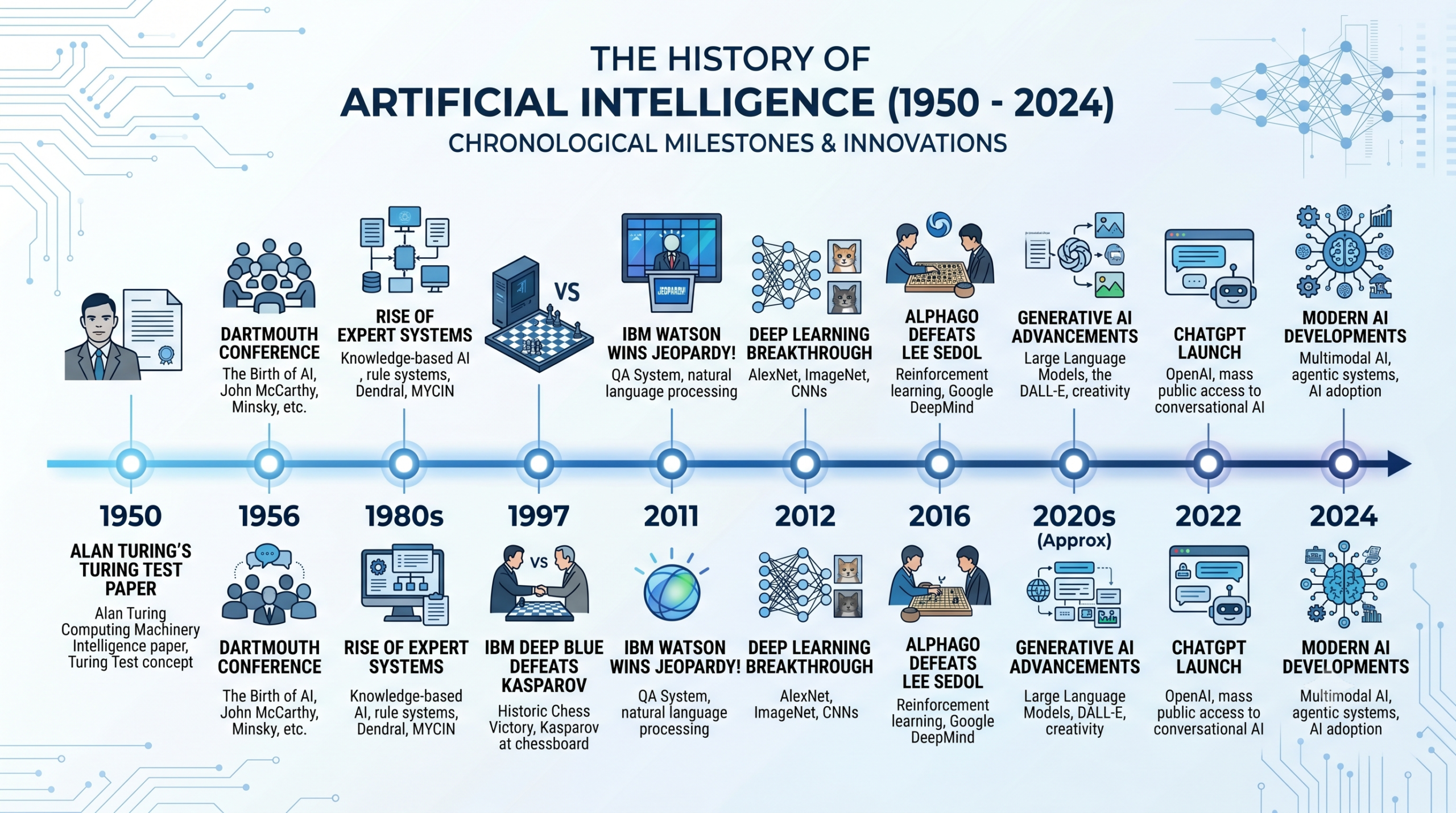
AI did not appear overnight. It has a longer history than most people realize, and understanding it helps you see where things are going.
1940s–1950s: The Theoretical Foundations
British mathematician Alan Turing laid the groundwork in 1950 with his paper Computing Machinery and Intelligence, where he asked: “Can machines think?” He proposed what we now call the Turing Test — a measure of whether a machine can converse indistinguishably from a human. Turing gave a lecture on machine intelligence as early as 1947, making him likely the first person to seriously explore the idea in a computing context.
1956: The Birth of AI as a Field
John McCarthy organized the Dartmouth Conference in 1956, officially naming and founding the field of “Artificial Intelligence.” This is when researchers first began formally working on getting machines to simulate human reasoning.
1960s–1970s: Early Enthusiasm and First “AI Winter”
Early AI programs could solve algebra problems and prove geometric theorems. Optimism was high — some researchers predicted human-level AI within 20 years. Reality was harder. Funding dried up when progress stalled, triggering the first “AI winter” (a period of reduced interest and investment).
1980s–1990s: Expert Systems and a Second Wave
Companies started using “expert systems” — AI programs that encoded the knowledge of human specialists. IBM’s Deep Blue defeated chess world champion Garry Kasparov in 1997, marking a milestone for narrow AI.
2000s–2010s: Machine Learning Takes Over
The internet gave AI researchers something they’d never had before: enormous amounts of data. Machine learning algorithms trained on this data began beating humans at specific tasks. In 2012, a deep learning model from the University of Toronto crushed the competition in the ImageNet image recognition contest, launching the deep learning era.
2017–Present: The Transformer Era and Generative AI
Google researchers published the influential “Attention Is All You Need” paper in 2017, introducing the Transformer architecture that powers modern large language models (LLMs). By 2022, ChatGPT became the fastest-growing consumer application in history. Today, generative AI is reshaping industries from healthcare to software development. If you want a deeper look at how investment and speculation are shaping this era, I wrote about it in detail in my guide to the AI bubble and the AI boom.
How Does AI Actually Work?
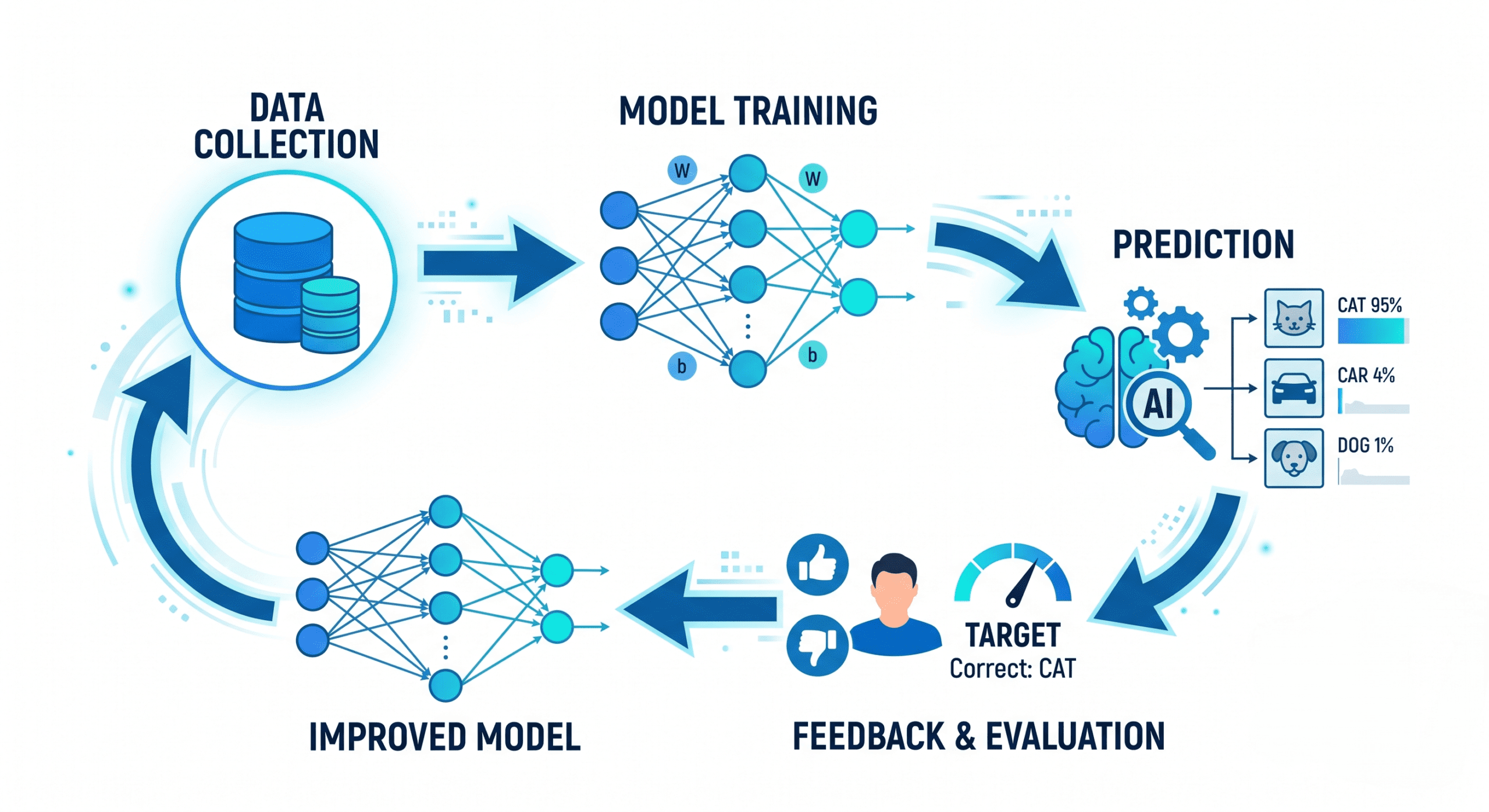
This is the part most beginner guides skip or explain poorly. Let me walk through it step by step in plain language.
Step 1: Data Collection
Every AI system needs data to learn from. This could be text, images, audio, numbers, or any other form of information. More high-quality data generally means a better AI model. Training GPT-4, for example, required processing a significant portion of publicly available text on the internet.
Step 2: Model Training
The AI algorithm processes that data and adjusts its internal parameters (called “weights”) to get better at a specific task. Think of it like a student studying for an exam — repeated exposure to examples helps the model improve its answers.
Step 3: Pattern Recognition
During training, the model learns to detect statistical patterns in data. A spam filter learns that emails with certain phrases and sender patterns are more likely to be spam. An image classifier learns that a combination of specific edges, colors, and shapes usually indicates a cat.
Step 4: Inference (Making Predictions)
Once trained, the model can take new, unseen input and make predictions or generate outputs. This is called “inference.” When you type a question into ChatGPT, the model is performing inference — predicting the most useful next words based on everything it learned during training.
Step 5: Feedback and Improvement
Many modern AI systems incorporate feedback loops. Reinforcement Learning from Human Feedback (RLHF), for example, uses human ratings of AI outputs to further improve model quality. This is how systems like ChatGPT were fine-tuned to be more helpful and less harmful.
Types of Artificial Intelligence: A Clear Breakdown
There are two major ways to classify AI: by capability and by functionality. Both classifications are useful depending on what you’re trying to understand.
Classification by Capability
| Type | What It Can Do | Examples | Does It Exist? |
|---|---|---|---|
| Artificial Narrow Intelligence (ANI) | One specific task | ChatGPT, Siri, AlphaGo, spam filters | ✅ Yes — all current AI |
| Artificial General Intelligence (AGI) | Any intellectual task a human can do | None yet — theoretical | ❌ Not yet |
| Artificial Superintelligence (ASI) | Surpasses human intelligence across all domains | None — science fiction concept | ❌ Does not exist |
It’s important to be clear about this: every AI system that exists today is Narrow AI. No matter how impressive ChatGPT or Google Gemini seem, they are specialized tools. They can’t truly reason, have no self-awareness, and fail badly outside their training domain.
Classification by Functionality
Researchers also classify AI by how it operates and remembers:
- Reactive Machines — Respond only to the current input with no memory. IBM’s Deep Blue (the chess computer) is a classic example.
- Limited Memory AI — Can use past data to inform decisions. This is most modern AI, including self-driving cars and recommendation engines.
- Theory of Mind AI — Would understand human emotions and social contexts. Still largely theoretical.
- Self-Aware AI — Would have consciousness and subjective experience. Does not exist.
Key AI Technologies You Should Know
AI is often described as a single thing, but it’s really a family of related technologies. Here’s a plain-English guide to the most important ones.
Machine Learning (ML)
Machine learning is the core engine behind most modern AI. Instead of being explicitly programmed for every task, ML systems learn from data. Give a machine learning model enough labeled examples (cat photos labeled “cat,” dog photos labeled “dog”) and it will figure out how to classify new photos on its own.
Deep Learning
Deep learning is a type of machine learning that uses multi-layered neural networks — computational structures loosely inspired by the human brain. These deep networks are exceptionally good at tasks like image recognition, speech understanding, and generating text. As NASA explains in their AI overview, deep learning sits inside machine learning, which in turn sits inside the broader field of AI.
Natural Language Processing (NLP)
NLP is the branch of AI that deals with human language. It powers everything from Google Search’s understanding of your query, to real-time translation apps, to the chatbots on customer service websites. Modern NLP is dominated by transformer-based large language models (LLMs).
Computer Vision
Computer vision allows AI to interpret visual information — images and video. It’s what lets your phone unlock with your face, what helps radiologists detect tumors in scans, and what enables self-driving cars to identify pedestrians and road signs.
Generative AI
Generative AI is the technology behind tools like ChatGPT, DALL-E, and Midjourney. It can create new content — text, images, music, code, and video — by learning patterns from massive training datasets. This is the branch driving most of the current excitement (and concern) in the AI field.
Reinforcement Learning
In reinforcement learning, an AI agent learns by trial and error — receiving rewards for correct actions and penalties for incorrect ones. It’s the technique behind DeepMind’s AlphaGo, which defeated the world’s top Go player, and it’s increasingly used in robotics and autonomous systems.
| Technology | Core Concept | Real-World Use Cases |
|---|---|---|
| Machine Learning | Learning from data | Fraud detection, email filtering, credit scoring |
| Deep Learning | Multi-layer neural networks | Image recognition, voice assistants, translation |
| NLP | Understanding human language | Chatbots, search engines, grammar tools |
| Computer Vision | Interpreting visual data | Facial recognition, medical imaging, self-driving cars |
| Generative AI | Creating new content | ChatGPT, DALL-E, GitHub Copilot |
| Reinforcement Learning | Learning via rewards/penalties | Game playing AI, robotics, recommendation systems |
Where Is AI Used in Real Life? (Everyday Examples)
You don’t have to look far to find AI in action. Most people interact with it dozens of times a day without realizing it.
In Your Smartphone
Face ID on your iPhone uses computer vision AI. Autocorrect and predictive text use NLP. Your camera’s scene detection, portrait mode, and night mode all use deep learning. Voice assistants like Siri, Google Assistant, and Alexa are pure NLP systems.
In Entertainment
Netflix’s recommendation engine predicts what you’ll want to watch next based on your viewing history and the behavior of millions of similar users. YouTube’s algorithm decides which video plays after yours. Spotify’s Discover Weekly playlist is curated entirely by AI.
In Healthcare
AI models now match or outperform human radiologists at detecting certain cancers in medical scans. AI is accelerating drug discovery by predicting how proteins fold (DeepMind’s AlphaFold). AI chatbots help triage patient symptoms in hospitals and clinics.
In Finance
Banks use AI to detect fraudulent transactions in real time. Trading firms use ML algorithms to execute millions of trades per second. Credit scoring models assess loan risk with greater accuracy than traditional methods.
In Transportation
Google Maps uses AI to predict traffic and suggest the fastest route. Tesla’s Autopilot and Waymo’s self-driving vehicles rely on computer vision and reinforcement learning. Airlines use AI to optimize routes and fuel consumption.
In Science and Research
NASA uses AI to analyze satellite data, detect potential asteroid threats, and support autonomous spacecraft navigation. AI is being used to model climate change, analyze genomics data, and identify new materials for energy storage.
In Everyday Software
Gmail’s spam filter. Google Search autocomplete. Amazon product recommendations. LinkedIn’s job suggestions. The grammar checker in Google Docs. All of these are AI systems running quietly in the background.
Benefits of Artificial Intelligence
AI offers genuine advantages that are already changing lives for the better. Here are the most significant:
- Speed and efficiency — AI can process and analyze data at a scale and speed no human team could match. A doctor might review 20 scans a day; an AI model can review 20,000.
- Availability — AI systems don’t sleep, take breaks, or get sick. Customer service chatbots, for example, can handle queries 24/7.
- Accuracy — In narrow, well-defined tasks, AI systems can achieve accuracy that exceeds human performance — particularly in pattern-heavy domains like radiology or quality control in manufacturing.
- Personalization — AI enables experiences to be customized to individual users at scale, from personalized learning platforms to tailored health recommendations.
- Automation of repetitive tasks — AI frees humans from tedious, repetitive work — data entry, sorting, scheduling — allowing people to focus on more complex and creative tasks.
- Scientific acceleration — From protein folding to climate modeling, AI is helping researchers tackle problems that would have taken decades using traditional methods.
Limitations and Risks of Artificial Intelligence
It’s equally important to understand what AI cannot do well, and where it can cause harm.
Bias and Fairness
AI models learn from historical data, and if that data reflects societal biases, the model will too. Facial recognition systems have been shown to be significantly less accurate for people with darker skin tones. Hiring algorithms have discriminated against women. Bias in AI is not a fringe concern — it’s a well-documented, mainstream problem.
Lack of Common Sense and Reasoning
Current AI systems are statistical pattern matchers — they don’t truly understand the world. Large language models can confidently state false information (a problem called “hallucination”). They lack causal reasoning, real-world grounding, and genuine understanding.
Privacy and Surveillance
AI makes mass surveillance vastly more practical. Facial recognition deployed in public spaces, AI-powered data mining of personal communications, and predictive policing systems all raise serious civil liberties concerns that vary by country and jurisdiction.
Job Displacement
AI will automate many tasks currently performed by humans. While it will also create new types of jobs, the transition is likely to be uneven — with workers in certain sectors (data entry, transport, customer service, some areas of law and accounting) facing significant disruption.
Security and Misuse
AI can be weaponized. Deepfakes (AI-generated fake videos) can spread misinformation. AI can be used to generate phishing emails, automate cyberattacks, or create disinformation at scale. These are active threats, not hypothetical ones.
Environmental Cost
Training large AI models consumes substantial amounts of energy. A 2023 study estimated that training a single large language model can produce carbon emissions equivalent to five cars driven over their lifetimes. As AI scales, this environmental footprint becomes a policy concern.
Narrow AI vs. General AI vs. Superintelligence: What’s the Difference?
These three terms come up constantly in AI discussions, and they often get confused. Here’s a clear breakdown.
Narrow AI (ANI) is what we have today. It’s AI that excels at one specific task — playing chess, translating languages, recommending movies. It performs that task well, sometimes better than any human, but it has no ability to transfer that skill to other domains. ChatGPT is Narrow AI. AlphaGo is Narrow AI. Every current AI system is Narrow AI.
Artificial General Intelligence (AGI) would be a system that can perform any intellectual task that a human can — not just the one it was trained for. It could switch from writing an essay to analyzing financial data to playing a game of chess, learning each task as needed. AGI does not exist today, and there is genuine debate about how close we are to achieving it.
Artificial Superintelligence (ASI) is a theoretical system that would surpass human intelligence in every domain — science, creativity, social intelligence, and problem-solving. This is the scenario described in science fiction and worried about by some researchers. It is entirely hypothetical and not something the field has come close to producing.
In plain terms: Current AI is a very smart tool. AGI would be a very smart colleague. ASI would be something beyond human comprehension. Only the first one exists.
AI Ethics: The Questions We Need to Answer
As AI becomes more embedded in critical decisions — who gets a loan, who gets parole, which job applicants are shortlisted — the ethical dimensions are no longer abstract. Here are the central questions the field is wrestling with:
- Accountability: When an AI system makes a harmful decision, who is responsible — the developer, the company deploying it, or the algorithm itself?
- Transparency: Many AI systems (especially deep learning models) are “black boxes” — it’s not clear why they make the decisions they do. Should systems making high-stakes decisions be explainable?
- Consent: Much AI training data was scraped from the internet without explicit consent from the people who created it. Is that acceptable?
- Equity: Will the benefits of AI be distributed broadly, or will they concentrate power and wealth in the hands of a few corporations and countries?
- Autonomy: As AI systems make more decisions, how much human oversight should be required — particularly in healthcare, criminal justice, and military applications?
The EU’s AI Act (2024) was the world’s first comprehensive AI regulation, categorizing AI applications by risk level and imposing obligations on developers. This is a fast-moving area — the legal and regulatory landscape will look very different in five years.
Common Misconceptions About AI
Misconception 1: “AI Is Basically a Robot”
AI is software — a set of algorithms and models. Robots are hardware. Some robots use AI to control their behavior (like Boston Dynamics’ robots), but most AI has no physical form at all. ChatGPT, Netflix’s recommendation engine, and a spam filter are all AI — none of them have a body.
Misconception 2: “AI Understands Things the Way Humans Do”
This is one of the most common and most consequential misconceptions. AI systems process patterns in data and generate outputs based on statistical probability. They do not understand meaning, context, emotions, or consequences the way a human does. When ChatGPT gives you a confident answer, it is predicting likely text — not reasoning from a deep understanding of truth.
Misconception 3: “AI Will Become Sentient Soon”
There is no scientific consensus that current AI architectures are on a path toward consciousness or sentience. The question of machine consciousness is genuinely unresolved in philosophy and neuroscience — but most AI researchers do not believe current language models are sentient or are close to becoming so.
Misconception 4: “AI Is Always More Accurate Than Humans”
In narrow, well-defined tasks with lots of data, AI can be more consistent than humans. But AI systems fail in ways humans don’t — confidently stating wrong information, misidentifying images when the input is slightly altered, or breaking down completely when encountering situations outside their training data.
Misconception 5: “You Need to Be a Programmer to Use AI”
Modern AI tools are built for everyone. You don’t need to code to use ChatGPT, Gemini, Canva’s AI features, or AI-powered writing tools. The gap between AI and non-technical users is closing rapidly.
The Future of Artificial Intelligence
I find this is where most guides either hype things up irresponsibly or get overly pessimistic. The truth is more nuanced — and more interesting.
What’s Likely in the Next 3–5 Years
- AI agents that can autonomously complete multi-step tasks (booking travel, writing and sending reports, managing workflows) will become mainstream
- AI tools will become standard in healthcare for diagnostics, treatment planning, and drug development
- AI will be embedded in nearly every major software product — from word processors to design tools to operating systems
- Regulation will increase significantly in the EU, US, and UK, shaping what AI products can and cannot do
What Remains Uncertain
- Whether AGI is achievable in our lifetimes — experts genuinely disagree on this, with serious researchers estimating timelines ranging from 5 years to never
- How labor markets will absorb AI-driven automation at scale
- Whether AI’s energy demands can be made sustainable
- Whether current approaches (scaling transformer models) will hit fundamental limits
For a thorough look at how AI investment patterns and market dynamics are shaping these developments, my guide to the AI bubble and boom covers the economic forces driving this period in depth.
One thing is certain: AI is not going away. The question is not whether it will reshape how we live and work, but how thoughtfully and equitably we manage that transition.
🔑 Key Takeaways
- AI is the science of building machines that perform tasks requiring human-like intelligence — learning, reasoning, and problem-solving.
- All AI that exists today is “Narrow AI” — it does one type of task well. Artificial General Intelligence (AGI) does not yet exist.
- AI works by learning patterns from large amounts of data, not by following fixed rules.
- Core AI technologies include machine learning, deep learning, NLP, computer vision, and generative AI.
- You already use AI every day — in your phone, email, streaming services, maps, and banking apps.
- AI offers major benefits in speed, accuracy, and automation — but carries real risks around bias, privacy, and job displacement.
- The Transformer architecture (2017) and large language models have defined the current era of AI development.
- Regulation of AI is growing — the EU AI Act (2024) is the world’s first major comprehensive AI law.
Frequently Asked Questions About AI
What is AI in simple words?
AI (Artificial Intelligence) is a branch of computer science that creates systems capable of doing things that normally require human intelligence — like understanding language, recognizing images, making decisions, and learning from experience. In everyday life, AI powers voice assistants, recommendation systems, spam filters, and search engines.
What are the main types of AI?
There are three types based on capability: Narrow AI (performs one task — all current AI), General AI (human-level across all tasks — does not yet exist), and Superintelligence (surpasses humans in every domain — theoretical). By functionality, AI is classified as Reactive Machines, Limited Memory AI, Theory of Mind, and Self-Aware AI — only the first two categories currently exist.
Who invented artificial intelligence?
John McCarthy coined the term “Artificial Intelligence” and organized the 1956 Dartmouth Conference that launched it as a formal field. Alan Turing laid the theoretical groundwork in 1950 with his paper on machine intelligence and the Turing Test. Both are considered founding figures of AI.
What is the difference between AI and machine learning?
AI is the broad field focused on creating intelligent machines. Machine learning is a subset of AI — a specific approach where systems learn from data to improve their performance on tasks without being explicitly reprogrammed. All machine learning is AI, but not all AI uses machine learning.
What is generative AI?
Generative AI is a category of AI that can create new content — text, images, audio, video, and code — based on patterns learned from large training datasets. It’s powered by large language models and diffusion models. Examples include ChatGPT (text), DALL-E and Midjourney (images), and Google Gemini (multimodal).
Is AI dangerous?
AI carries real, near-term risks: algorithmic bias, job displacement, privacy erosion, disinformation via deepfakes, and security vulnerabilities. These are active concerns being addressed through regulation and responsible AI frameworks. Existential risk from superintelligent AI remains a matter of debate among researchers — but it is not a near-term threat based on current technology.
What is the Turing Test?
The Turing Test, proposed by Alan Turing in 1950, measures whether a machine can hold a conversation indistinguishable from a human. An observer interacts with both a human and a machine by text; if the observer cannot reliably tell which is which, the machine is considered to have passed. Modern AI systems can pass simplified versions of this test, though this is a subject of ongoing debate.
How is AI used in everyday life?
AI is used in: voice assistants (Siri, Alexa), streaming recommendations (Netflix, Spotify), email spam filtering, smartphone face unlock, GPS navigation, online shopping recommendations, banking fraud detection, and search engine results. Most digital products you use daily incorporate AI in some form.
What is the difference between deep learning and machine learning?
Machine learning is the broad technique of teaching computers to learn from data. Deep learning is a specialized type of machine learning that uses neural networks with many layers (“deep” networks). Deep learning requires more data and computing power but excels at complex tasks like image recognition and language understanding that simpler ML models struggle with.
Can AI replace humans?
AI will automate many specific tasks currently done by humans — especially repetitive, data-heavy work. But current AI cannot replicate human creativity, complex judgment in novel situations, emotional intelligence, or physical dexterity across diverse environments. The more realistic near-term story is AI changing how jobs are done rather than making entire professions obsolete — though specific roles will be significantly disrupted.
Conclusion
Artificial intelligence is not a single technology and not a science fiction concept — it’s a broad and rapidly growing field that is already embedded in the technology you use every day. Understanding what it actually is, how it works, what it can and can’t do, and where it might go is no longer just useful for researchers and engineers. It’s increasingly important for everyone.
The short version: AI is software that learns from data to perform specific intelligent tasks. All current AI is Narrow AI — impressive, useful, and at times transformative, but not a thinking, feeling, conscious being. The genuine concerns around AI are mostly near-term and human-made: bias in training data, concentration of power, job market disruption, and the potential for misuse.
The more you understand AI, the better you’ll be able to use it effectively, spot its limitations, and participate in the conversations about how it should be built and governed.
If you’re curious about the investment boom and speculative dynamics surrounding AI right now, my guide to the AI bubble and the AI boom digs into the economic forces shaping this moment in detail.
Sources and further reading: NASA’s introduction to artificial intelligence | IBM’s AI research and explainers | Google Cloud’s AI guide